

Blue swimmer crabbing near Adelaide: raking, drop nets and the rules
How to catch blue swimmer crabs in Gulf St Vincent this summer, from raking the tidal flats north of Adelaide to drop nets off a jetty, with the PIRSA rules, handling tips and how to stay safe on the flats.
6 min read

In this article
On a still summer morning the shallows of Gulf St Vincent turn into one of the state’s favourite outdoor larders. The gulf’s sandy bottoms and seagrass meadows suit blue swimmer crabs, and South Australians head out with rakes, floating tubs and drop nets to catch a feed.
This guide explains the two main ways to catch them, where people go, the rules PIRSA sets and how to stay safe on the flats. Rules and conditions change, so check the official sources before every trip.
The short version
- Two methods: raking in knee-deep water over sand, or drop nets lowered from a jetty.
- Where: the tidal flats north of Adelaide, the suburban jetties, and towns on Yorke Peninsula such as Ardrossan and Wallaroo.
- When: calm, clear days around low tide. An old local saying favours months with an ‘r’ in them, which covers the whole summer.
- The rules: measure every crab as soon as you catch it, return undersize crabs and egg-carrying females straight away, and check the daily limits in the SA Fishing app.
- Watch out: soft mud, the sun and the incoming tide.
Raking the tidal flats
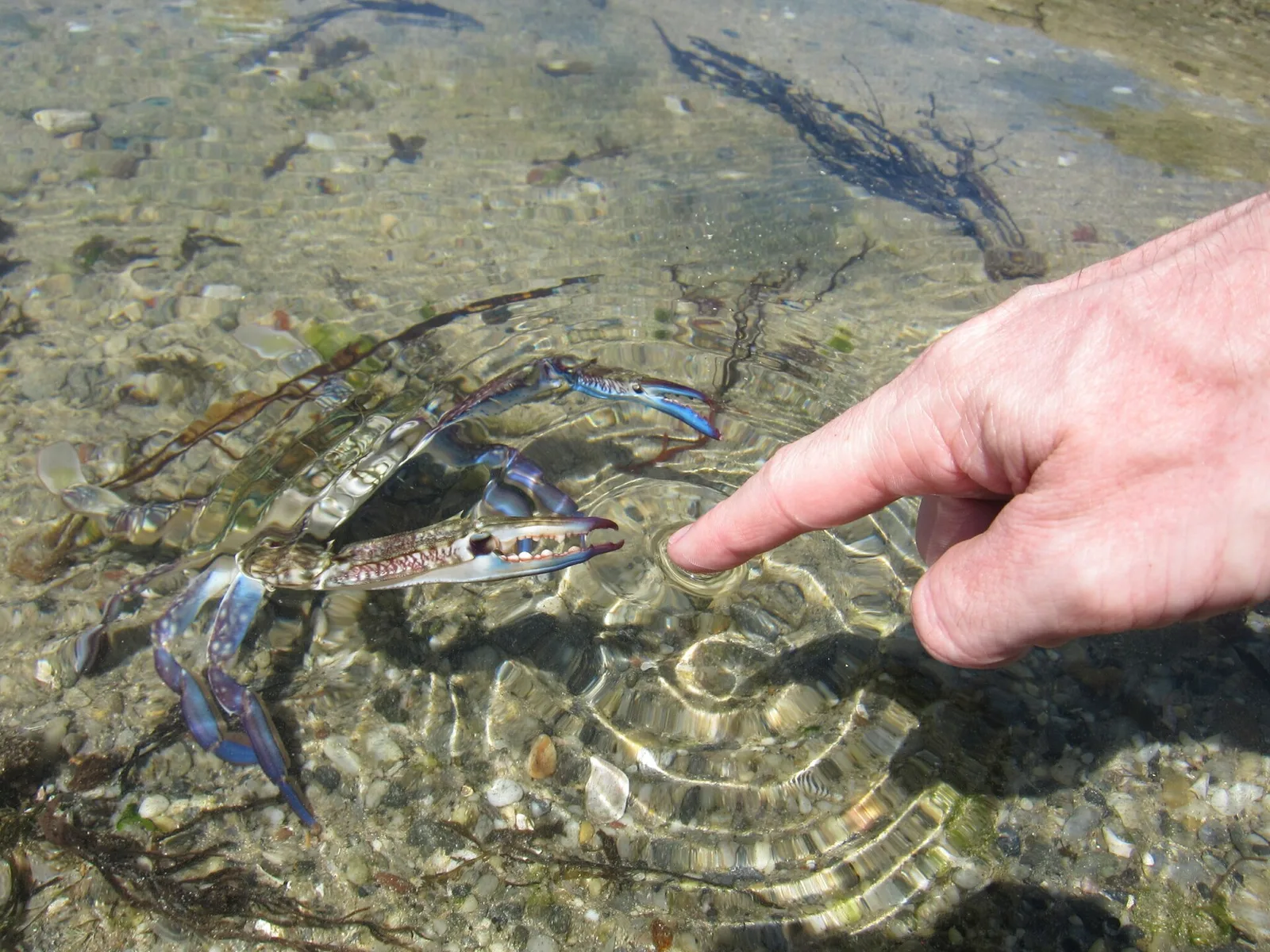
Raking is the classic method. Wade out to about knee depth over a clear sandy patch and scan the bottom for two small eyes poking out of the sand, or a slightly disturbed, greyish patch. Run the rake over it and the crab usually comes up claws first. Lift it into a buoyant tub towed behind you, and be ready to prise off crabs that grab the rake.
The RAA names Thompson Beach as one of several raking spots on the broad tidal flats between St Kilda and Port Parham, north of Adelaide. Tides there are extreme and the flats look far bigger at low tide. Its advice is to head out at low tide and work your way back to shore as the water comes in, staying around knee depth. The shoreline is part of the Adelaide International Bird Sanctuary and the waters offshore are a marine park, so move carefully, especially when driving, and give feeding shorebirds plenty of room.
Pick a calm day. Wind chops up the surface and you cannot see the crabs. Yorke Peninsula’s tourism body suggests working around low tide while the water is moving.
Drop nets from a jetty
A drop net is two hoops joined by a net bag. Bait it, lower it to the bottom from a jetty and pull it up every so often to see what has wandered in. Many people fish with a rod while the nets soak. The RAA says catches from Adelaide’s suburban jetties tend to be smaller than in the best regional spots, though a good day can still make a decent meal. Our jetty fishing guide covers the metropolitan jetties.
PIRSA’s drop net rules include:
- a maximum hoop size and net depth, and a limit on how many nets each person may use
- no tag needed for a net set from the shore while you stay with it at all times
- a white buoy and a tag with your name and address if a net is left unattended
- bait of fish or fish-based products only: no meat, chicken or other poultry in drop nets or hoop nets in marine waters
Crab rakes are also a permitted gear type.
Yorke Peninsula: a crabbing road trip
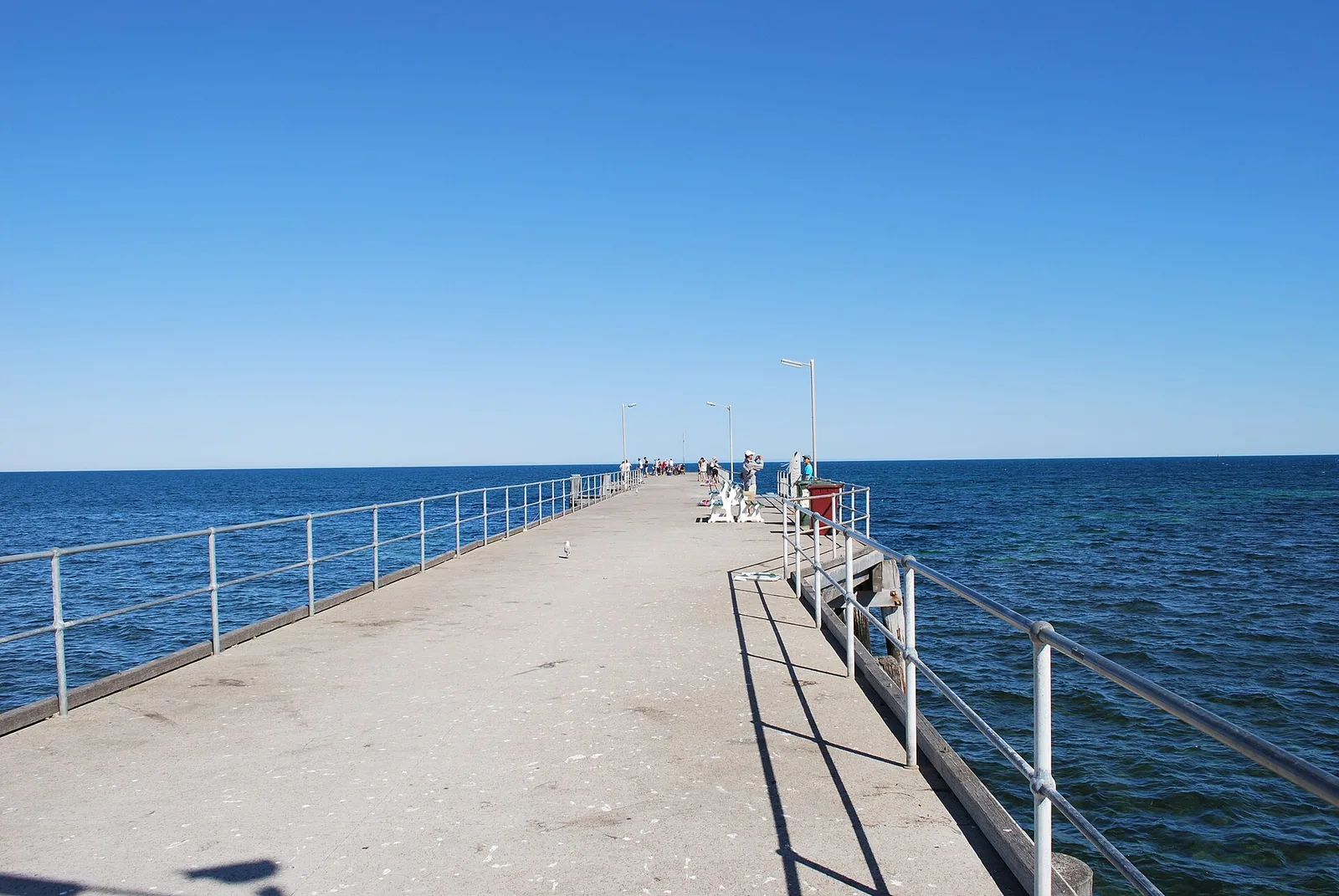
For a longer trip, the RAA singles out two Yorke Peninsula towns. At Ardrossan you can drop nets from the jetty and rake the shallows around it and at Tiddy Widdy Beach, just north of town. Wallaroo’s jetty is known for big crabs, with Port Hughes and Moonta Bay a few kilometres away. The RAA notes that part of Wallaroo jetty can be closed when ships are in port. See our Yorke Peninsula trip guide for planning the drive.
The rules
PIRSA, the state fisheries agency, sets the rules for blue swimmer crabs. We do not quote the numbers here because limits can change, but these principles apply:
- Minimum size: crabs are measured across the shell from the base of the largest spines. Measure every crab as soon as it is caught and put undersize crabs back immediately. PIRSA’s Fishwatch line can send you a free crab measuring device.
- Females carrying eggs: these are totally protected and must go straight back into the water.
- Daily limits: there are personal bag and boat limits, which count blue swimmer crabs and sand crabs together. Find the current figures in the free SA Fishing app or on PIRSA’s website.
- No selling: recreational fishers cannot sell their catch.
- Closures: check the app’s closure map before you go. Some areas, such as sanctuary zones, are closed to all fishing.
Look out for Asian paddle crabs
PIRSA has confirmed four detections of the Asian paddle crab, an aggressive non-native species, in Gulf St Vincent and the Port River since 2019. It is smaller than a blue swimmer, comes in pale, olive, brown or purple shades, has six spines down each side of the shell, and both sexes have paddle-shaped rear legs. If you think you have caught one, do not put it back. Take a photo, keep it in a bucket of seawater and call Fishwatch on 1800 065 522 straight away.
Handling and cooking your catch
Keep your catch cool and shaded. Yorke Peninsula’s tourism body suggests chilling crabs in a slurry of ice and salt water before cooking, then cooking them in seawater or well-salted water without crowding the pot until they turn bright orange-red.
The state government’s algal bloom advice is that crabs you catch yourself are safe to eat if they are cleaned thoroughly and gutted before cooking.
Getting there
The northern flats are a short drive north of the city, reached from St Kilda or, at the northern end, Thompson Beach. Suburban jetties are on public transport routes; check the Adelaide Metro journey planner. Ardrossan and Wallaroo are a long day trip by car.
Before you go
- Check the tide: know when low tide is and when the water turns, and keep an eye on it.
- Protect your feet: wear old sandshoes or strong footwear against rocks and sharp shells, and avoid the soft, seagrass-covered mud, which the RAA warns can trap you.
- Beat the heat: SA Health advises exercising outdoors early or late in the day, drinking plenty of water, and wearing a hat, loose light clothing, sunglasses and SPF50+ sunscreen when the UV is 3 or above.
- Take a bucket and ice: plus a measuring device, a towel and a tub that floats.
For more on the coast, see our wetlands and birdwatching guide, our heatwave safety guide and our South Australian seafood guide.
Frequently asked questions
When is crabbing season near Adelaide?
Crabs are caught in Gulf St Vincent through much of the year, and summer is a popular time to go. A local saying favours months with an r in them. Calm, clear days around low tide give the best chance of seeing crabs in the shallows.
Do I need a licence to go crabbing in South Australia?
No licence is needed for recreational fishing, including crabbing, but size, bag, gear and closure rules apply. Check them in PIRSA’s free SA Fishing app before you go.
What bait can I use in a drop net?
In marine waters PIRSA allows fish or fish-based products in drop nets and hoop nets. Meat, chicken and other poultry are not allowed.
What should I do with a female crab carrying eggs?
Return it to the water immediately. Female blue swimmer crabs with external eggs are totally protected in South Australia.
Where can I rake for crabs near Adelaide?
The tidal flats between St Kilda and Port Parham north of Adelaide, including Thompson Beach, are popular. Go at low tide, stay around knee depth, avoid soft mud and give shorebirds space.
Your next customer could start right here.
Introduce your business to people discovering Adelaide: locals, visitors and the businesses that serve them.
Explore placements and request a private quote
Sources
Where the facts come from
The 7 references this article was checked against.
- Blue Swimmer Crab (opens in a new tab)
PIRSA · pir.sa.gov.au
Measuring, protection of females with eggs, combined limits with sand crabs and bait rules for nets.
- Drop net (opens in a new tab)
PIRSA · pir.sa.gov.au
Drop net specifications, numbers and marking rules.
- Asian Paddle Crab (opens in a new tab)
PIRSA · pir.sa.gov.au
Detections, identification and how to report.
- 4 of SA’s top crabbing spots (opens in a new tab)
RAA SA Move · samove.raa.com.au
Thompson Beach, suburban jetties, Wallaroo and Ardrossan, with tide and footwear advice.
- Crabbing (opens in a new tab)
Yorke Peninsula Tourism · visityorkepeninsula.com.au
How to rake, conditions, and chilling and cooking crabs.
- Algal Bloom Update (opens in a new tab)
Government of South Australia · algalbloom.sa.gov.au
Advice on eating self-caught crabs.
- Healthy in the Heat (opens in a new tab)
SA Health · sahealth.sa.gov.au
Staying healthy outdoors in hot weather.
Comments
No comments yet. Be the first to join the conversation.
Leave a comment
Every comment is read by a moderator before it appears. Your email address is never published; it is used only to contact you about this comment.
More from Adelaide Sphere

Local guideThings to do
Semaphore: the jetty, the Time Ball Tower and a classic seaside main street
A guide to Semaphore on the Lefevre Peninsula: the long jetty, the 1875 Time Ball Tower, heritage Semaphore Road, the foreshore with its 1928 carousel and steam train, Fort Glanville, and the train from the city.
By Adelaide Sphere

Local guideThings to do
Where to watch the sunset in Adelaide: jetties, beaches and Hills lookouts
Adelaide’s coast faces west, so the sun goes down over the sea. Where to watch it, from the Henley, Brighton, Semaphore, Grange and Port Noarlunga jetties to Mount Lofty, Windy Point and Light’s Vision, and how to plan the evening.
By Adelaide Sphere

Local guideThings to do
South Australian Museum: a guide to the galleries, free entry and visiting with kids
What to see at the South Australian Museum on North Terrace: the Australian Aboriginal Cultures Gallery, Pacific cultures, the Ediacara fossils, opal fossils, minerals and megafauna, plus tips for visiting with children.
By Adelaide Sphere